


Which Natural Baby Shampoo Is Right for Your Newborn?
Quick Summary
A natural baby shampoo for a newborn should be gentle, plant-derived, and free of harsh surfactants, synthetic fragrance, and drying alcohols. Choose a fragrance-free formula with a short, readable ingredient list, and patch test before full use.
- Look for fragrance-free formulas, since fragrance is a common irritation trigger in infant products.
- Avoid strong sulfates such as sodium lauryl sulfate, which can strip natural oils from delicate skin.
- Wash newborn hair two to three times a week, as more frequent washing can dry the scalp.
- Patch test a small amount behind the ear or on the inner arm, and wait a day or two before full use.
Table of Contents
- What Makes a Natural Baby Shampoo Suitable for a Newborn
- Newborn Shampoo Ingredients to Avoid
- 5 Natural Baby Shampoos for Newborns Compared
- Baby Shampoo for Sensitive Skin: What to Check on the Label
- How Often to Wash Newborn Hair
- Using Shampoo Safely on Delicate Newborn Skin and Scalp
- Choosing Your Newborn's First Natural Shampoo
- Frequently Asked Questions
Which Natural Baby Shampoo Is Right for Your Newborn?
Last Updated: November 21, 2026
What Makes a Natural Baby Shampoo Suitable for a Newborn
A natural baby shampoo is a gentle, plant-derived cleanser made without harsh surfactants, synthetic fragrance, or drying alcohols. For a newborn, that matters because infant skin and scalp are thinner and more easily irritated than adult skin. A baby shampoo formulated with organic aloe juice and prebiotics is one option to consider when comparing natural baby shampoos.
Start with the label. Look for a formula that is fragrance-free or uses only a mild, clearly listed fragrance, and check the label for any testing claims. American Academy of Dermatology guidance on infant skin care
Not every "natural" claim carries the same weight, so check the ingredient list itself. A short, readable list of botanical ingredients is usually easier to assess than a long one. EU cosmetics regulation and ingredient labelling rules
Newborn Shampoo Ingredients to Avoid
Some ingredients are common in adult shampoos but are harsher than most parents want for a newborn. Sodium lauryl sulfate and other strong sulfates can strip natural oils from delicate skin. Synthetic fragrance and artificial dyes are frequent triggers of irritation, and parabens are often avoided by parents who prefer simpler formulas.
A "fragrance-free" label is not always the same as "unscented." Some products mask odour with added scent, so read the full ingredient list rather than relying on the front of the bottle.
A gentler approach is to choose a shampoo built around a few well-understood plant ingredients. For example, the Gentle Baby Shampoo from Aromanatura, Inc. uses organic aloe juice and linden flower extract, and its listing states that it is vegan.
5 Natural Baby Shampoos for Newborns Compared
A useful comparison of natural baby shampoos has to be reproducible: the same criteria, applied the same way, to every product. Below is the scoring rubric this comparison uses, followed by how to apply it to five shortlisted formulas. The rubric is the part most roundups skip, and it is the part that lets you swap in whichever products are available where you live without losing the logic.
The comparison criteria
Each shampoo is assessed on six disclosed criteria, scored 1-5, for a maximum of 30 points:
| Criterion | What earns a high score | Why it matters for a newborn |
|---|---|---|
| Ingredient transparency | Full INCI list published; every botanical named | You cannot assess a formula you cannot read |
| Surfactant base | Mild non-ionic or glucoside surfactants; no strong sulfates | Cleanses without stripping the thin newborn scalp |
| Fragrance status | Fragrance-free, or a single clearly listed scent component | Fragrance is a common irritation trigger in infant products |
| Newborn suitability | Explicit age guidance, ideally from birth | A "baby" product is not automatically a newborn product |
| Certification and testing | Recognised organic certification plus dermatological testing | Independent checks beat front-of-bottle claims |
| Value and packaging | Clear volume, sensible price per unit, practical dispenser | Everyday usability, not just the formula |
How the five shortlisted formulas score
1. Aromanatura Gentle Baby Shampoo. Organic aloe juice, linden flower extract, betaine, and prebiotics, with a mild organic fragrance and organic certification. Parents who want a strictly unscented product may prefer a fragrance-free option.
2. A fragrance-free glucoside wash. Formulas built on coco-glucoside and decyl glucoside with no added fragrance typically score highest on the fragrance and surfactant criteria. The trade-off is that "fragrance-free" is not the same as "unscented", some products use masking agents, so read the full list.
3. An organic-certified shampoo-and-body-wash combination. Combination products save shelf space and reduce the number of formulas touching a newborn's skin. Score them on whether the same formula is genuinely mild enough for both hair and body, not just on convenience.
4. A colloidal-oatmeal or oat-extract formula. Oat is a well-known soothing botanical and appears in many sensitive-skin lines. Check that the oat is named on the ingredient list rather than implied by marketing copy.
5. A minimal-ingredient newborn wash. The shortest readable list, often a mild surfactant, water, and one or two humectants, is easiest to assess and often the safest first trial for very reactive skin.
Reading the scores
A high total does not mean a product is right for your baby; it means it is easier to justify on paper. Weight the criteria to your own priorities: if your newborn has reacted to scented products before, treat fragrance status as a pass/fail gate rather than one-sixth of the score. If cost matters, compare price per unit rather than bottle price, since volumes vary widely.
Watch out: a product marketed as "natural" can still contain a strong surfactant or a masking fragrance, so score the ingredient list, not the front label.
Browse the gentle baby shampoo to check the full ingredient list and product details, and pair it with a baby body wash if you want a matching product for the rest of the bath routine.
Baby Shampoo for Sensitive Skin: What to Check on the Label
Looking for "gentle" and "fragrance-free" is a starting point, but it is not enough on its own to assess a sensitive-skin formula. This section walks through the label ingredient by ingredient, explains what natural and organic claims do and do not establish, and sets out when to stop guessing and ask a clinician.
Ingredient-by-ingredient assessment
Surfactants. These do the cleaning. Mild options include coco-glucoside, decyl glucoside, cocamidopropyl betaine, and sodium cocoyl isethionate. Strong sulfates such as sodium lauryl sulfate are harsher and more likely to strip oils from a thin newborn scalp. A formula can be plant-derived and still use a strong surfactant, so check the name, not the marketing.
Preservatives. Any water-based shampoo needs preservation to stay safe. Parabens are widely avoided by parents, but the alternatives are not automatically gentler, some leave-on and rinse-off preservatives are themselves recognised contact allergens. A short, clearly listed preservative system is easier to assess than an undisclosed "preservative blend."
Fragrance. This is the single most useful line to check. "Fragrance-free" means no scent is added; "unscented" can mean scent was added to mask the base. For reactive skin, fragrance-free is the safer default, and a clearly listed single scent component is the next best option.
Botanical extracts. Aloe, linden flower, oat, and chamomile appear in many sensitive-skin lines. Named botanicals are easier to assess than vague "botanical complex" wording. Evidence for individual plant extracts in infant skin is limited, so treat them as supporting ingredients rather than guarantees.
Dyes and drying alcohols. Artificial dyes add no cleansing benefit, and drying alcohols can irritate. Both are reasonable to avoid in a newborn formula.
What "natural" and "organic" actually establish
Natural and organic labelling does not automatically mean safe. Some plant-derived ingredients are irritants, and "natural" is largely a marketing term in many markets. Organic certification is more meaningful because it is audited against a published standard, but it speaks to how ingredients were grown, not to whether the finished formula suits a newborn. Treat certification as one positive signal among several, alongside a full ingredient list and dermatological testing.
A practical sensitive-skin routine
Patch test before full use: apply a small amount behind the ear or on the inner arm, wait a day or two, and watch for redness. Wash infrequently, two to three times a week suits many newborns, and rinse thoroughly. If redness, scaling, or persistent irritation appears, stop using the product.
If irritation spreads, weeps, or does not settle after a few days, or if you suspect eczema or a scalp infection, speak with your paediatric clinician.
How Often to Wash Newborn Hair
Most newborns do not need daily shampooing. Washing two to three times a week is enough for many babies, and more frequent washing can dry the scalp. If there is visible cradle cap, speak with your paediatric clinician about how often to cleanse the scalp. Scalp health is an important part of hair care, and our guide to the importance of scalp care explains how to keep the scalp in good condition.
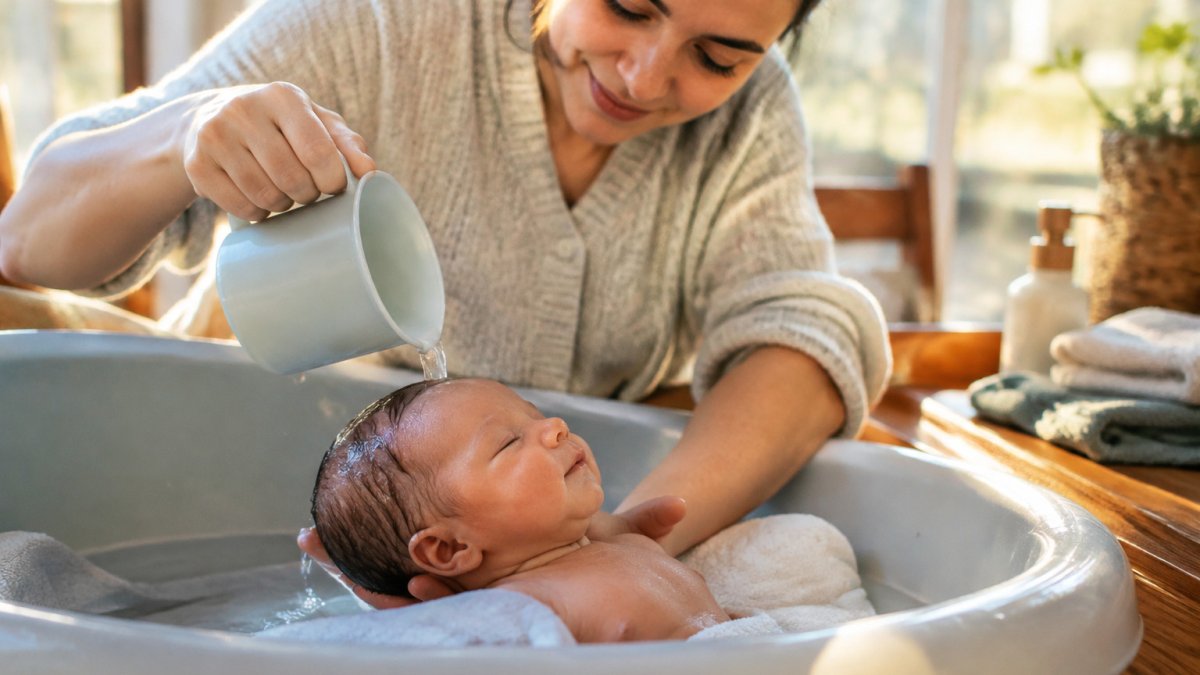
A parent gently rinsing a newborn's hair in a warm bath with a soft cup, in bright natural light, is a simple way to keep water temperature and pressure comfortable.
Using Shampoo Safely on Delicate Newborn Skin and Scalp
Use only a small amount, lather gently with your fingertips, and rinse thoroughly. Keep the product away from the eyes. If shampoo does get into the eyes, rinse with plain lukewarm water. Warm the water to a comfortable temperature, test it on your inner wrist, and support the baby's head throughout. Store the bottle out of direct sunlight and keep it closed between uses.
Choosing Your Newborn's First Natural Shampoo
Start by deciding how much fragrance you want, then check the ingredient list, testing claims, and price. The Gentle Baby Shampoo from Aromanatura, Inc. is one option for parents who want an organic, vegan option at an accessible price. If your baby has a known sensitivity, patch test first and consult your paediatrician. Learn more about natural skincare to decide which routine suits your family best.
Choosing a shampoo for a newborn does not have to be complicated. Aromanatura, Inc. makes a gentle, organic option with a clear ingredient list. Shop the Gentle Baby Shampoo to see whether it fits your baby's routine.
Frequently Asked Questions
What is the best shampoo for a newborn baby?
For most newborns, the best shampoo is a fragrance-free, mild formula with a short ingredient list and no harsh sulfates. The Gentle Baby Shampoo from Aromanatura, Inc. is formulated with organic aloe juice, betaine and prebiotics, and it includes linden flower extract for soothing. It is dermatologically tested and marketed for all skin types. Apply a small amount to wet hair, lather gently and rinse thoroughly, avoiding the eyes. Check the label for the ingredients you want to avoid before buying, and talk to your pediatrician if your baby has a scalp condition.
Are fragrance-free shampoos better for newborns with sensitive skin?
Fragrance-free or lightly scented formulas are often easier on sensitive skin because they contain fewer potential irritants. The Gentle Baby Shampoo from Aromanatura, Inc. contains a mild organic-based fragrance, so it is not entirely unscented, and that is worth knowing if your baby reacts easily. Watch for redness, dryness or rash after the first few uses, and stop using the product if irritation appears. A pediatrician or dermatologist can advise on persistent skin concerns.
How often should you wash a newborn's hair?
Most newborns do not need their hair washed every day. Two to three times a week is usually enough to keep the scalp clean and prevent a buildup of milk residue or cradle cap flakes. Wash more often only if the scalp becomes visibly oily or dirty. Over-washing can dry the delicate scalp, so use a small amount of mild shampoo each time and rinse well.
Can newborns use baby shampoo from birth?
A mild baby shampoo designed for infants can generally be used from birth, but use only a small amount and keep it away from the eyes. Newborn skin is thin and easily irritated, so choose a product made for delicate skin and stop if you notice redness or rash. If your newborn has a skin or scalp condition, ask your pediatrician before using any new product.
